
1,3,4Rashtrasant Janardhan Swami College Of Pharmacy, kokamthan, Ahmednagar, Maharashtra-414001
2Assistant Professor-Rashtrasant Janardhan Swami College Of Pharmacy, kokamthan, Ahmednagar, Maharashtra-414001
5Student-Matoshri Radha College of Pharmacy, Virgaon, Akola, Maharashtra-422605.
This study explores the preparation and application of acid-base indicator paper extracted from rose and hibiscus flowers, utilizing their natural pigments, primarily anthocyanins, as pH indicators. The process involves steeping the petals of these flowers in water to extract the vibrant colorants, which are then absorbed onto filter paper, resulting in a functional indicator tool. The paper’s performance is evaluated across a range of pH levels, demonstrating a marked color change that correlates with acidity and alkalinity: red or pink in acidic solutions, purple in neutral, and blue or green in basic conditions. The use of natural indicators provides an eco-friendly alternative to synthetic pH indicators while highlighting the potential of plant-based resources in educational and practical applications in chemistry. This study underscores the importance of natural indicators in promoting sustainable practices in pH measurement and reinforces the aesthetic and functional roles of botanical materials in scientific exploration.
Acid-base indicator paper made from extracts of rose and hibiscus flowers is a natural pH indicator. These flowers contain pigments, mainly anthocyanins, which change color in response to changes in pH.
- Rose petals and hibiscus flowers are rich in anthocyanins, which are water-soluble pigments.
2. pH Sensitivity:
- The color of the extract changes based on the acidity or alkalinity of the
solution:
- In acidic conditions (pH < 7>
- In neutral conditions (around pH 7), the color is typically purple.
- In basic conditions (pH > 7), the color can shift to blue or green.
3. Preparation:
The flowers are steeped in water to extract the pigments, which are then dried onto paper strips, creating a color-changing indicator. Acid-base indicators are substances that change color in response to changes in pH. The use of natural plant extracts as pH indicators has gained popularity due to their Eco friendliness and effectiveness. Rose and hibiscus flowers, known for their vibrant colors, contain anthocyanins, which are responsible for their hue and can serve as a natural pH indicator. Composition and Properties: -Anthocyanins: The primary pigments in rose and hibiscus flowers that react to pH changes. These water-soluble pigments are found in the vacuoles of plant cells and can display different colors depending on the acidity or alkalinity of the environment. Preparation of Indicator Paper
1.Extraction: -
Petals of rose and hibiscus flowers are collected and washed. The petals are then soaked in boiling water, allowing the anthocyanins to Natural pH indicators offer a sustainable alternative to synthetic dyes in measuring acidity and alkalinity. This study focuses on creating acid-base indicator paper using extracts from rose and hibiscus flowers, both known for their vibrant colors due to the presence of anthocyanins. These compounds exhibit a unique ability to change color in response to varying pH levels, making them ideal for educational and practical applications in chemistry.
Chemical Basis: -
Anthocyanins: These are water-soluble pigments found in various flowers, including roses and hibiscus. They can appear red, purple, or blue, depending on the pH of the solution they are in: Acidic solutions (pH < 7> 7). ### Acid-Base Indicator Paper Extracted from Rose and Hibiscus Flower. Acid-base indicator paper derived from rose and hibiscus flowers serves as a natural alternative for measuring pH levels. The paper utilizes the color-changing properties of anthocyanins, pigments found in these flowers, which exhibit distinct hues based on the acidic or alkaline nature of the solution they are exposed to. Components: -Rose (Rosa spp.) **: Various species of roses produce pigments that can change color in response to pH variations. Hibiscus (Hibiscus sabdariffa): This flower is particularly rich in anthocyanins, making it an excellent source for pH indicators. Color Changes in Response to pH The extract from rose and hibiscus flowers demonstrates apredictable range of colors based on the pH of the solution: Acidic Conditions (pH < 7>
Rose: -
Kingdom: -Plantae. Clade: -Tracheophytes
Clade: Angiosperms. Clade: Eudicots
Clade: Rosids. Order: Rosales
Family: Rosaceae. Subfamily: Rosoideae
Tribe: Roseae. Genus: Rosa L.
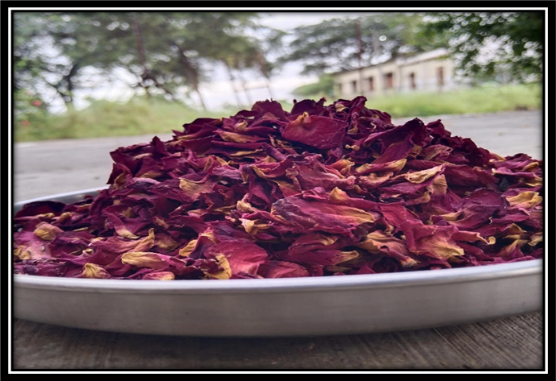
Fig.1:-Rose Dry Flower
The flowers of most species have five petals, with the exception of Rosa omeiensis and Rosa sericea, which usually have only four. Each petal is divided into two distinct lobes and is usually white or pink, though in a few species yellow or red. Beneath the petals are five sepals (or in the case of some Rosa omeiensis and Rosa sericea, four). These may be long enough to be visible when viewed from above and appear as green points alternating with the rounded petals. There are multiple superior ovaries that develop into achenes. Roses are insect-pollinated in nature. The aggregate fruit of the rose Is a berry-like structure called a rose hip. Many of the domestic cultivars do not produce hips, as the flowers are so tightly petalled that they do not provide access for pollination. The hips of most species are red, but a few (e.g. Rosa pimpinellifolia) have dark purple to black hips. Each hip comprises an outer fleshy layer, the hypanthium, which contains 5–160 “seeds” (technically dry single-seeded fruits called achenes) embedded in a matrix of fine, but stiff, hairs. Rose hips of some species, especially the dog rose (Rosa canina) and rugosa rose (Rosa rugosa), are very rich in vitamin C, among the richest sources of any plant. The hips are eaten by fruit-eating birds. such as thrushes and waxwings, which then disperse the seeds in their droppings. Some birds, particularly finches, also eat the seeds.
Hibiscus: -
Kingdom: Plantae. Clade: Tracheophytes
Clade: Angiosperms. Clade: Eudicots
Clade: Rosids. Order: Malvales
Family: Malvaceae. Subfamily: Malvoideae
Tribe: Hibisceae. Genus: Hibiscus L.

Fig.2:-Hibiscus Dry Flower
-Hibiscus is a genus of flowering plants in the mallow family, Malvaceae. The genus is quite large, comprising several hundred species that are native to warm temperate, subtropical and tropical regions throughout the world. Member species are renowned for their large, showy flowers and those species are commonly known simply as “hibiscus”, or less widely known as rose mallow.
-The genus includes both annual and perennial herbaceous plants, as well as woody shrubs and small trees. The generic name is derived from the Greek name ??????? (ibískos) which Pedanius Dioscorides gave to Althaea officinalis Several species are widely cultivated as ornamental plants, notably Hibiscus syriacus and Hibiscus rosa-sinensis. A tea made from the flowers of Hibiscus sabdariffa is known by many names around the world and is served both hot and cold. The beverage is known for its red colour, tart flavour, and vitamin C content.
COMPOUNDS USED AS A NATURAL INDICATOR
Anthocyanin: -
The Flavonoid anthocyanin has a positive charge oxygen atom on its C-ring. Anthocyanin’s stability is a ected by pH, light, temperature, and its chemical structure. On the anthocyanin structure. at the 7th position, the R group can be incorporated. Various groups such as a methoxyl group, sugar, and other speci c substitutions could in uence the colouring behaviour of anthocyanin. Anthocyanin preparation derived from grape juice tanks has been allowed for use in human food, beverage production, and so drinks, according to the Food Drug and Administration (FDA). At low pH, anthocyanins are stable. When subjected to heat, however, it loses its stability, resulting in colour loss and browning. Anthocyanin molecules are present in the equilibrium of a solution between the coloured cationic form and the colourless pseudo base form. pH has a direct impact on this equilibrium, which is critical for the colour of anthocyanins. In acidic solutions, anthocyanins create red, violet or purple in neutral solutions and blue in alkaline solutions. Because anthocyanins have aavylium cation in their structure, the cyanidin molecule is protonated and produces a cation at low pH. When the pH rises, the molecules deprotonate, and a reaction occurs.e effect of changes in anthocyanin structure based on the surrounding solution and is depicted. ere fore, most of the anthocyanins colourant’s can only be used at a pH below four. Additionally, most of the anthocyanin molecules can act as pH indicators in acid-base titration.
NATURAL INDICATOR: -
Natural-based indicator plays a vital role during titration. Currently, various plants were used as a natural indicator, and their colour changes in a di erent medium (acidic medium or basic medium) at di erent pH has listed.
Rose: -
There are hundreds of species and thousands of cultivated varieties (cultivars) of rose. They come in a variety of forms, from the more traditional shrubs and climbers, to miniature pot plants. Their stems are usually prickly and their glossy, green leaves have toothed edges. Rose flowers vary in size and shape. They burst with colours ranging from pastel pink, peach, and cream, to vibrant yellow, orange, and red. Many roses are fragrant, and some produce berry-like fruits called hips.
Plant uses: -
1) Beauty and cosmetics
Fragrant essential oils from rose flowers are added to perfumes and candles. Rose extracts and essential oil are also added to hair care products as they are nourishing and moisturizing. Rose water (a by-product from rose oil production) is a popular ingredient in facial mists and toners.
2) Cultural: -
Red roses are one of the most iconic symbols of love. According to ancient Greek mythology, roses were created by Aphrodite, the Goddess of love. In ancient Rome, newlywed couples were crowned with roses. In medieval times, roses were associated with power and victory in battle. During the War of the Roses (English civil wars for control of the throne), roses symbolized the Houses of York and Lancaster. Roses are often grown as ornamental plants for their beautiful and sometimes fragrant flowers. They are popular garden plants but are sometimes grown indoors and are used as cut flowers. In Japan, the rose is a symbol for homosexuality.
3) Food and drink: -
Rose hips are a source of vitamin C that was used in World War II in syrups. It is also an ingredient in some preserves such as jam and marmalade and can be found in some jelly and tea. The hips are also eaten by fruit-eating birds, including thrushes and pheasants, that help disperse the seeds in their droppings. Other birds, like finches, eat the seeds. Rose water is commonly used in Middle Eastern and Indian cooking, especially in sweets such as baklava, nougat, and Turkish delight.
4) Health: -
The rose species, China rose (Rosa chinensis), has been used in traditional Chinese medicine. The roots and fruits are used for arthritis, joint pains, coughs, and skin wounds and infections. The flower buds are used to stimulate blood flow and help with chest and abdominal pain.
FACTORS INFLUENCING THE COLOUR OF THE INDICATOR: -
Effect of temperature on the colour of the indicator temperature has an impact on the colour-based chemicals’ stability. Natural pigments like Curcuma and tulip petals show no colour change at 98°C and 92°C, respectively while borage at 60°C changes red-purple colour. Studies have revealed that the pH of a solution shows an inversely proportional relationship with temperature except for water. A solution is considered acidic if the excess of hydrogen ions is present over the hydroxide ions. In the case of pure water, the hydrogen and hydroxide hydroxide ions concentrations are always the same because of neutral characteristics (even if their pH changes).
CONCLUSION: -
Acid-base indicators made from natural materials rose, and hibiscus flowers could be used to determine acid or base Solutions’ properties. The calibration results of rose and hibiscus extracted ethanol’s in pH 1-12 showed significant colour Changes. Thus, both extracts could be combined to create acid-base paper indicators by using Whatman 42 paper. It Showed colour changes in strong acid (pink), a weak acid (faded light pink), weak base (faded light green), and strong Base (green brownish). The indicator papers from natural materials had superiorities, such as more economical, Reachable materials, and less contrast-Colour degradation. The materials also could prevent environmental pollution And are more durable than natural liquid indicators.
REFERENCES



Nandkumar M. Chaudhari*, Suraj D. Bendre, Savil V. Deshmukh, Ashish S. Kumbhakarn, Vaishnavi S. Jondhale, Acid Base Indicator Paper Extracted From Rose And Hibiscus Flower, Int. J. of Pharm. Sci., 2024, Vol 2, Issue 10, 1712-1720. https://doi.org/10.5281/zenodo.14006458
 10.5281/zenodo.14006458
